Uncategorized

How Locobuzz AI Makes CX the Most Strategic Function in the Room

TL;DR The article makes the case that CX has become the most strategic function in a business, because trust, loyalty, and growth are now decided in everyday customer moments. It explains why traditional, reactive CX models fall short in a world of fast-moving conversations, emotional signals, and rising expectations and why CX teams need intelligence that goes beyond speed and ticket closure. It walks through how Locobuzz AI rewires the CX operating model from the first customer signal to final resolution. The platform listens across channels, decodes emotion and intent, prioritizes conversations using contextual relevance, and supports agents with AI-generated responses and real-time coaching. The focus is on catching risk early, routing what truly matters, scaling empathy, and helping teams act with clarity instead of guesswork. It shows the real, measurable business impact of instinct-led CX across industries. From earlier crisis detection and faster prioritization to higher CSAT, better agent performance, lower churn, and stronger retention, the article demonstrates how AI-powered CX moves teams from firefighting to relationship-building. The end result is CX evolving from a support function into a trust engine that shapes outcomes at scale. Customer Experience is no longer a service layer, it’s the core of how trust is earned, how loyalty is built, and how brands grow in real time. The most admired companies in the world aren’t defined by their products alone. They’re remembered for how they make people feel during moments of need, in everyday interactions, and when it matters most. That emotional edge is now a business advantage. And it’s being shaped, delivered, and scaled by CX teams. But here’s the truth: you can’t lead with experience if you’re stuck reacting to it. In a landscape where conversations explode without warning, where sentiment shifts by the hour, and where expectations outpace processes, CX needs more than human effort. It needs connected intelligence. An ecosystem that can detect intent, sense emotion, understand context, and empower teams to act faster, respond smarter, and serve better. That’s the transformation Locobuzz AI enables. It’s not just about efficiency. It’s about elevation. About giving CX teams the instinct to know what matters, the clarity to align with business goals, and the tools to become architects of trust, not just executors of support. With Locobuzz AI, your CX becomes the most strategic function in the room. And, that changes everything. From Resolution to Relationship: The New Mandate for CX Teams Did they feel heard? Understood? Cared for? This emotional layer of CX, which was long ignored, is now the battleground for loyalty and trust. Locobuzz AI is built to strengthen that layer. To give CX teams superpowers to scale not just speed, but empathy, intelligence, and consistency. This is the story of how. This is the story of the future unfolding now! Locobuzz AI: Rewiring the CX Operating Model Locobuzz isn’t just a support tool. It’s a full-stack, AI-driven customer experience transformation engine that powers: Smart listening across channels Emotional and intent detection Intelligent ticket triage Hyper-contextual, multilingual responses Agent coaching in real-time Deep, scalable personalization Let’s walk through how the system flows. Deep Dive into The Locobuzz AI Journey for CX: From the First Signal to the Final QC When You Catch What Customers Feel Early, You Can See What Others Miss In a high-volume customer care ecosystem, the challenge isn’t just answering tickets. it’s knowing which ones need attention first, and why. The difference between a simple query and a hidden escalation often lies in the tone, urgency, and intent buried in the message. ContextualPulse™ decodes this layer. With advanced emotional and intent recognition AI, it reveals what customers truly mean, spotting dissatisfaction masked as politeness, loyalty cues in casual praise, or churn risks behind neutral feedback. SignalSense™ works alongside it, scanning every digital channel for the earliest whispers of risk or opportunity, even before they show up in your queue. It flags urgency, emotional shifts, and emerging trends so you can prioritize and respond proactively.Together, they turn ticket management from a reactive process into an instinct-driven system, ensuring the right issues get solved first, and every customer feels truly understood. QRIC Engine – Prioritize What Matters Most The QRIC engine (Query Relevance, Intent, Context) helps CX teams focus their energy where it matters most: Urgent complaints are routed to escalation teams instantly Loyalty signals are flagged for retention campaigns Purchase intent is surfaced for sales follow-up Low-priority or repetitive questions are resolved automatically or asynchronously What this means: No wasted time. No missed opportunity. Just smarter routing and faster resolution. Response & Coaching: Where AI Becomes a Teammate ResponseGenie™ – Sound More Human, At Scale. Imagine a system that taps into your KnowledgeBase, understands your brand tone, past conversations, FAQs, and customer emotion, and crafts replies that sound like your best agent, every time. That’s ResponseGenie™ for you! Generates natural, relevant responses in 200+ languages Maintains tone consistency across agents, shifts, and geographies Adapts tone and complexity to match each customer profile Impact Stats: A global e-commerce brand using ResponseGenie™ saw: 62% reduction in average response time 21% increase in CSAT A 50% increase in first-contact resolutions Agent IQ™ – Real-Time Coaching. Lifelong Improvement. Your best agents aren’t just fast, they’re thoughtful, calm, and emotionally intelligent. Agent IQ™ helps every agent become their best self, by providing real-time feedback on: Tone mismatch Emotional inconsistency Response clarity Brand language alignment Knowledge accuracy The AI learns from each agent’s style and customer outcomes, providing hyper-personalized coaching nudges, not just error correction. The Measurable Shift with Locobuzz AI: From Blindspots to Breakthroughs See the transformation when you stop reacting late and start trusting on instincts! Before Locobuzz AI With Locobuzz AI Issue Discovery Risks found after public escalation. Signals flagged up to 7 days sooner. Ticket Prioritization Manual triage delays by 12–24 hrs. QRIC routes priority cases in <45 mins. Trend Spotting Shifts missed for days, trends unseen. Real-time alerts cut crises by 37%. Response Quality Inconsistent, generic customer replies. ResponseGenie™ lifts CSAT by 21%. Agent Performance Feedback after QA, slow improvement. Agent IQ™ boosts agent efficiency by

How Locobuzz AI Makes CX the Most Strategic Function in the Room Read More »
How Locobuzz is Redefining CX with AI at the Core

TL;DR The article explains how Locobuzz is built as an AI-first operating system for CX and marketing, where AI runs through everything, listening to customer signals across channels, understanding emotion and intent, and turning that intelligence directly into action. It’s positioned as a shift away from fragmented tools and dashboards toward one unified system. It shows how this changes day-to-day work for CX and marketing teams, helping them move from reacting to issues after they happen to anticipating problems, spotting trends early, prioritizing conversations by urgency and context, and responding faster with more relevance and consistency using AI-assisted workflows. It ties everything together around alignment and scale, where marketing and CX share the same intelligence, insights flow both ways, teams stop working in silos, and brands operate with more clarity, speed, and confidence across every touchpoint. Customer experience is no longer a function, it’s the frontline of competitive advantage. But the real edge doesn’t come from dashboards or data. It comes from intelligence so sharp, it stops feeling like insights, and starts feeling like instinct. From knowing, not guessing what customers need before they ask. That kind of instinct used to be rare. Now, it’s engineered. At Locobuzz, we’ve architected a platform where AI isn’t an add-on, it’s the operating system. A platform that unifies CX, digital care, marketing intelligence, automation, and analytics into a single, intuitive platform. From intelligently triaging complex ticket inflow to emotion-aware insights, every interaction, every signal, every decision is powered by real-time AI. We don’t just enable customer experience teams to listen; we help them anticipate, respond, and lead. Locobuzz enables teams to move from fragmented workflows to fluid, intelligent action. Because the world’s greatest innovations weren’t born from data. They were born from instinct. And we’re building that instinct into the very core of CX, for every CX and marketing team baked into every workflow, in real time. Why Today’s CX & Marketing Teams Need a Whole New OS Legacy tools weren’t built for the way brands operate today. Fragmented channels, unpredictable customer journeys, surges of data with no signal, and expectations that scale faster than your team ever can. And when teams are forced to toggle between dashboards, export data into decks, and act on lagging metrics. It’s not just inefficient, it’s dangerous. You miss moments. You misread sentiment. You react instead of lead. What today’s teams need isn’t another tool. They need an intelligent layer that connects the dots before humans can. A system that sees around corners, automates what should never be manual, and elevates the role of human teams into one of leadership, not reaction. Thats where Locobuzz shines through. Locobuzz isn’t a tool for managing CX. It’s the command centre for building it. For Marketing Teams: From Chasing Trends to Creating Them Marketing today isn’t about monthly reports; it’s about minute-by-minute intuition. But most marketers still rely on stitched-together tools, siloed insights, and campaign metrics that show up after the moment has passed. Locobuzz changes that too. With AI-powered signal detection, marketers see what’s building before it peaks. Trends are tracked at the seed, not the headline. Customer sentiment, pain points, and product love surface in real time and not in post-mortems. Campaigns don’t operate in isolation. They’re fuelled by live CX data, customer feedback loops, and real-time reputation signals. You get instant answers to questions like: What are our customers loving today? Which content triggered replies, and which silence? Are we leading the conversation or following it? Locobuzz puts marketing in the driver’s seat where instinct is powered by intelligence. For CX Teams: From Managing Noise to Mastering Nuance Customer Experience today is no longer about response times alone. It’s about relevance, empathy, and precision at scale. But when teams toggle between tools, sift through irrelevant alerts, and rely on lagging indicators, they lose more than just time; they lose trust. Locobuzz changes that. It brings contextual intelligence to the frontline. Escalations aren’t based on volume, they’re driven by urgency, emotion, and your brand’s tone of voice. Conversations aren’t missed in the chaos, they’re surfaced in real time, tagged, prioritized, and nudged into workflows that your teams can act on instantly. From social DMs to app reviews, from WhatsApp to email, Locobuzz sees every customer signal and connects the dots before they break. No more copy-pasting into decks. No more manual reporting. Just real-time visibility. Intelligent routing. Unified context. So CX teams stop reacting and start leading. Locobuzz sees every customer signal and connects the dots before they break. The Result? One System. Two Power Teams. Total Harmony. Marketing and CX don’t just align. They move as one. Insights from service interactions directly inform creative strategy. Live customer feedback flows into content decisions. Every touchpoint becomes a chance to listen, learn, and lead. This is how modern teams scale: Connected data. Connected teams. Connected decisions. Because CX and marketing leaders don’t need more dashboards. They need a real-time intelligence layer that makes sense of the noise, sharpens instinct, and unlocks proactive, precise action. That’s what Locobuzz delivers. Not just a tool, but the OS for brands that want to move smarter. It equips you with a system that recognizes intent, decodes emotion, spots patterns early, and moves with clarity across every channel, touchpoint, and workflow. Escalations are based on urgency, context, and your brand’s tone of voice, not just keywords. Crisis signals are identified early, with clear paths to action. Trends are mapped as they form, giving you the edge to lead conversations instead of reacting to them. Marketing and CX don’t just coexist, they operate in sync. Insights from service interactions instantly inform campaign strategies. Customer feedback feeds directly into creative decisions. Real-time listening fuels real-time action whether that means a faster reply or a smarter marketing push. This is how CX and marketing scale with precision: connected data, connected teams, connected decisions. CX and Marketing leaders today don’t need more dashboards. They need real-time, AI-powered instincts. That’s what Locobuzz delivers. Meet the AI OS that

How Locobuzz is Redefining CX with AI at the Core Read More »

locobuzz-speed-accuracy

3 Crore+ Mentions, 25 Lakh+ Tickets, 15 Seconds: Locobuzz is Built for Scale, Engineered for Speed, & Trusted for Accuracy

TL;DR The article explains how Locobuzz is engineered to handle massive CX volumes without slowing down. We’re talking crores of mentions, lakhs of tickets, and millions of customer interactions processed every month, with every mention enriched and ready for action in under 15 seconds. Speed here isn’t a claim, it’s a system-level guarantee. It breaks down the architecture that makes this possible at scale. Auto-scaling infrastructure, microservices, advanced thread management, zero-downtime design, and enterprise-grade database failover work together so the platform stays stable during spikes, crises, campaigns, and migrations, all without human intervention or performance drops. It reinforces that speed only matters when accuracy is rock solid. The article highlights how Locobuzz prioritizes contextual intelligence, high-confidence enrichment models, low-latency querying, and continuous learning loops, ensuring insights are reliable, responses are relevant, and brands build trust through timely, precise engagement, even under extreme load. Timing is everything when it comes to customer experience. Miss a mention, delay a response, or overlook a review, and you might lose more than just a moment. Today, when our average attention span has dropped all the way to only 8 seconds, brands no longer have the luxury to respond slowly. Every customer interaction is a window of opportunity or a risk. And, the speed at which that window opens and closes determines the outcome. Processing over 55 million customer data points annually and delivering real-time insights in under 15 seconds, Locobuzz combines speed with precision at scale. It’s more than just a platform that listens – it responds faster, understands deeper, and scales wider, ensuring your customer experience is always a step ahead. We bring precision to every customer touchpoint – shaping experience, one interaction at a time! Let’s take a closer look at how Locobuzz is engineered to deliver speed, accuracy, and scale as a default, not a feature. Speed That Puts You On The Map Before You Even Notice When a customer tags your brand, leaves a review, or comments on your post, there’s a small, critical window to respond. At Locobuzz, we ensure that this window is 15 seconds – from the moment the mention is made to the moment it’s fully enriched and ready for action by your team. Here’s what’s happening behind the scenes: Scale That Proves the Platform’s Power Locobuzz isn’t just built to listen, it’s built to listen at scale without compromising on speed or efficiency. Here’s the volume that the platform recently processed in a month: Metric Monthly Volume Mentions Captured 3.74+ Cr (37,475,697) User Mentions 3.42+ Cr (34,198,233) Brand Posts Tracked 32.77+ Lakh (3,277,549) Tickets Created 28.64+ Lakh (2,864,955) Tickets Closed 19.97+ Lakh (1,997,414) Replies Sent 12.15+ Lakh (1,215,290) Unique Customers Interacted 5.03+ Lakh (503,318) These numbers are not projections, they’re actual platform usage volumes. But, how does Locobuzz handle this kind of traffic seamlessly? Auto-Scaling Infrastructure The platform dynamically adjusts compute capacity during volume spikes. No human intervention needed. Whether it’s a PR crisis or a festive season campaign, Locobuzz keeps up. Microservices Architecture Each service – routing, analytics, enrichment – runs independently. If one encounters a load, only that part scales up, keeping the rest lean and efficient. Thread Management to Eliminate Bottlenecks With advanced thread pooling using T-3459 configuration across secondary servers, Locobuzz avoids thread starvation even under extreme concurrency, enabling peak load handling with zero slowdowns. Zero Downtime Experience This architecture ensures no single point of failure. Real-time performance stays stable even under peak loads. Backed by Enterprise Grade Architecture The platform is built on a backbone of over 400 SQL Server databases configured with AlwaysOn Availability Groups, ensuring built-in failover. If any node fails, another takes over instantly — there’s no room for disruption. Accuracy That Brands Can Trust Speed and volume are meaningless without accuracy. What makes Locobuzz dependable is its precision-first approach: Enrichment Quality Benchmarking: Each enrichment model (sentiment, topic, intent) is benchmarked for <300ms performance and high-confidence outputs before being deployed. Contextual Intelligence: The platform goes beyond keyword analysis. It considers user history, platform tone, language nuances, and prior sentiment, making insights more reliable. Learning Loop: Agent outcomes, customer reactions, and ticket trends are constantly fed back into the engine, making the system more intelligent over time. Low-Latency Querying with Redis Caching: To maintain real-time speed even at scale, high-frequency queries are cached using Redis, which eliminates repetitive database hits and dramatically improves response latency. Side Quest: A Migration Story That Speaks Volumes About Our Efficiency Locobuzz’s platform isn’t just high-performance on paper, it’s been tested under extreme conditions multiple times. Let’s look at one such instance – During a major infrastructure migration, cloud engineers estimated it would take ~45 days to move 48 terabytes of live data, with up to 5 days of downtime. The Locobuzz team completed it in just 2 days, and with zero downtime. It was proof of solid performance under extreme pressure. The agility wasn’t just technical, it was cultural. Locobuzz Is Made for the Moment & for Faster CX With all systems built for speed, accuracy, and scale, brands using Locobuzz achieve: 45% faster response times Intelligent ticket routing with full enrichment Real-time campaign sentiment tracking Customer trust built through timely, relevant engagement Everything is designed to ensure that brands never miss a moment. Your customers don’t wait. Your insights can’t lag. And, your responses must be smart and fast. Locobuzz is built to power this level of performance, every single day. From crores of mentions to individual customer interactions, Locobuzz makes speed, accuracy, and scale not just possible, but effortless. It’s in our DNA!

3 Crore+ Mentions, 25 Lakh+ Tickets, 15 Seconds: Locobuzz is Built for Scale, Engineered for Speed, & Trusted for Accuracy Read More »

Guide on social-listening linkedin

Complete Guide to Social Listening on Linkedin

Are you fully leveraging the power of LinkedIn for business? If you presently use LinkedIn only for personal branding and job searching, you underutilize one of the most potent B2B and B2C connectivity tools. If done strategically, social listening will help you amplify your brand image, attract the best talent, and contribute to business growth. A good social listening strategy brings into view several valuable insights from beyond native analytics into your audience’s interests, concerns, and tastes. Knowledge is power, and this will surely help you create very targeted and engaging content for your target market. More importantly, it enables you to understand your audience and make your brand the thought leader in the target market for good customer and prospect relationships What is Social Listening for LinkedIn? Social listening for LinkedIn entails the process of monitoring or assessing what is being said about to, or by your brand, industry, or specific topics on the LinkedIn platform. It is one very valuable tool that businesses can use in trying to understand their audience, track industry trends, and fine-tune the marketing strategies. Business owners must listen to the direct and indirect mentions of your brand, as well as those of your competitor, to understand how it is perceived. The customer gives feedback about your brand, thus helping one find areas they may need to improve and respond in time. As with any social media, listen for industry-specific keywords to stay up to date with the trends, collaborating opportunities, and conversations you can join in and show your expertise to help position your brand as an industry thought leader. What is Social Listening? Social listening can be described as a robust tool through which any business can keep tabs on online conversations concerning their brand, industry, and competitors. You will get valuable information by monitoring mentions, sentiment, and trends that could give insight into marketing strategies for the betterment of business. With social listening, for example, one can identify the trending and wider context of changes in industries, make use of such knowledge to develop a better-suited content strategy for their audience, and deliver timely customer service that sorts out customers’ issues. It also helps to make relationships with social influencers to widen their reach, boost their credibility, and measure campaign performance. Also, social listening positions a business in a position where it can make more informed decisions, cultivate superior relationships with customers, and realize satisfactory profitable growth. Why is Social Listening Important? Social listening monitors how consumer behavior changes and makes decisions to stay relevant with customers. Besides learning about your customers through marketing, social listening helps amass data about the industry and competitors. It comprehends the experience a customer is having with what you provide and presents opportunities to work with influencers or even other brands. Consumer behavior keeps shifting, and in case of not paying attention to those changes, customers may get lost to the competitors and make poor business decisions. Understanding Engagement through Social Listening The mastery of engagement on social media will effectively link businesses with their audience as it could be very meaningful. Social listening gives insight into what your audience is talking about, their needs, and trends within the industry. Learning from your audience, responding with care, and positioning your brand as an opinion leader helps you have stronger relationships and drive effective engagement. 1. Understanding your Audience To develop engagement in social media, you have to learn about what your audiences say about your brand as it helps you tailor your strategy to meet their needs precisely. You should then focus on those conversations from where you can derive meaningful insights like brand mentions, industry trends, competitive analysis, and customer feedback. For this, you would need to track the right keywords and hashtags that customers use and it should be relevant to them and the brand itself, such as the brand name, campaign-specific hashtags, or industry-specific terms. After tracking, you have to analyze the sentiment of these conversations, whether they perceive your brand positively, negatively, or neutrally. 2. Reply to them with Attentiveness A response strategy for social media mentions is responding to customer service issues as quickly as possible, giving positive feedback, and conversing where relevant. At the core of any thoughtful response is timing and tone, Swift responses nip small concerns before they grow into full-blown problems. It shows to your audience that their satisfaction is of the essence to you and that you are committed to resolving their issues with your brand. Besides the timely response, acknowledging the feedback way to encourage more in the future. How well you respond shows off your brand personality, but again, the tone is allowed to vary according to the context of a conversation. Tailored responses show that you listen, understand, and know how to value the sentiment behind each mention. 3. Placing your Brand as a Thought Chief Social listening helps in targeting the topics and interests of the target audience. With respective hashtags and industry keywords, you will be connected to conversations taking place around you. Influencers are people having the power to affect the opinions and trends of industries on social media. These people come with huge numbers of followers and can influence sentiments about your brand. When you take part in the discussion they contribute to by actually having a conversation with them and sharing expertise and insight, the relationships that result may lead to collaboration, thereby enhancing visibility and credibility. Social listening on LinkedIn creates change in the way businesses connect professionals and industry leaders through engagement art. The Power of Social Listening for LinkedIn Success LinkedIn is one such social media networking platform that presents many opportunities for digital marketers to build their brands and drive sales. It, therefore, creates a very great avenue for social listening in the sense that from it, one should be able to gain insight from their audience, track industry trends, and then have their marketing strategies optimised. 5 Benefits of Social Listening

Complete Guide to Social Listening on Linkedin Read More »

customer-experience-tools-in-india

15 Best Customer Experience Tools in India

Well, in the ever-more-competitive environment, customers experiencing better is no longer just nice but necessary; also, with the rise in using digital technologies and evolving expectations, Indian businesses have been on the quest to explore innovative tools and strategy designs that help enhance these relationships with their customers.  With that, this article will take you through an emerging CX tool that disrupts the functioning patterns of business in India. In the next section, we will find out how these tools will help you gain an edge over competitors, achieve long-lasting relationships with your customers and eventually fuel business growth. Ranging from AI-powered chatbots to sophisticated analytics platforms, there are a whole lot of functionalities that enable one to make streamlined operations possible while personalizing the interaction. With such a wide understanding of the core features and the benefits attached, you would be better positioned to make informed decisions toward optimizing the customer experience strategy and realizing long-term success. What is a Customer Experience (CX) Tool? A Customer Experience (CX) tool is the software solution for making the interaction between a business and its customers better. It helps in understanding customer behavior, preferences, and pain points in order to make the best-informed decisions to enhance the customer journey as a whole. Top 15 Customer Experience Tools in India Companies are embracing CX tools to be at a competitive advantage by providing excellent customer experience, loyalty, and business growth. Let’s take a look at the 15 best customer experience tools. 1. Locobuzz In this digital world, where customer experience is the key, Locobuzz is the new tool for businesses to listen, engage, and respond to their customers effectively. By providing powers of AI and machine learning, Locobuzz enables brands to track all social media conversations, makes it easy to analyze their customers’ sentiments, and identifies negative issues at the right moment to tackle them, thus enhancing the brand’s loyalty from its customers. Key Features: Reputation Management: Protect and strengthen your online brand reputation. Social Media Listening: Monitor brand mentions and industry trends on any social media through AI Social Listening.  Social Sentiment Analysis: Gauge how customers feel towards your brand. Crisis Management: Instant and real-time recognition and response towards a probable crisis on the social front. Hence, it provides a step-by-step crisis management plan. Customer Service: Better management of a large customer query and issues and resolution. Advanced Analytics: Critical insights about the behavior and patterns of customers with preference analysis. AI-Based Insights: AI for an automatic mode in tasks, action insights can be derived from various points to be utilized.  Critical notifications: Immediate push for mention and issue points. Dashboard with Customization Options: Creating different dashboards focusing on vital points and KPIs as and when required. 2. Salesforce Service Cloud Salesforce Service Cloud is a powerful customer service platform for businesses to give their customers the best possible experiences. It integrates all perspectives about the interaction with customers via phone, e-mail, chat, and even through social media. Some features such as case management, knowledge base, and automated workflows are specifically meant to ensure that all processes involving support go very smoothly, leading to fast response and increasing satisfaction with the customers. Key Features: Case Management: Track and address all issues across customers fast and efficiently. Knowledge Base: Enables self-service options to the customer, which enables most to solve their problems at once. Automated workflows: It helps in repeated tasks of employees with increased productivity due to agents. Omni-channel routing routes:  Customer’s queries to skilled available agents in real-time. Analytics with real-time customer behavior analysis and service performance monitoring in real-time.It suggests what customers will request to have and what aspects should be automated using artificial intelligence. Field Service Lightning: It streamlines field service processes ensuring the efficiency of the technique. Community Cloud: It enables communities for customer engagement and knowledge sharing. 3. Qualtrics XM Qualtrics XM is the end-to-end experience management platform. It helps companies understand and design customer, employee, product, and brand experiences.  They have tools to collect, analyze, and then act on data based on feedback. Qualtrics XM with AI-powered insights drives organizations toward trends and prioritizing and changing actions as required. Key Features: Customer Experience (CX): Collect and analyze customer feeling by conducting surveys, polls, and feedback forms. Employee Experience (EX): This measures the degree of employee satisfaction, engagement, and productivity level. Product Experience (PX): It retrieves information regarding usability and design performance of the product. Brand Experience (BX): Tracked perception of the brand and reputation. AI-Powered Insights: This uses AI to automate analysis and help discover actionable insights. Advanced Analytics: Get deep in data to see the trends and correlations. Real-time Reporting: Track key metrics in real-time. Actionable Recommendations: Get specific recommendations on how to improve experiences. Seamless Integrations: Connect to other tools and systems to make workflow streamlined. 4. Zendesk Among the most sought customer service platforms, which made business deliver great experiences to its customers, is Zendesk. This platform comprises a set of tools involved in the operation of delivering customer services on multiple communication channels like emails, chats, phone, and even social media. It fastened quicker responses, answers to questions, and more relation with the clients through such features as ticketing, knowledge base, and analytics. Key Features: Ticketing System: Ticketing system helps in proper follow-up and prioritizing the issues of customers correctly and resolving them. Knowledge Base: Build and maintain an autonomic knowledge base that caters to the customer on one’s own. Live Chat: Start interacting with the customers on the go by live chatting. Email Support: Manage large volumes of Inbound Customer Emails. Phone Support: Handle both Inbound and Outbound Calls. Achieve Maximum Utilization from calls.   Analytics and Report: Get Customer Conversation Intelligence in addition to the Activities of an Agent. Automation: Maximize utilization from Automated Recurring Business Operations. Integrate other applications and software systems that work in isolation by leveraging Integration. 5. Medallia Medallia is the leading experience management platform, which allows business organizations to listen to the voices of customers

15 Best Customer Experience Tools in India Read More »

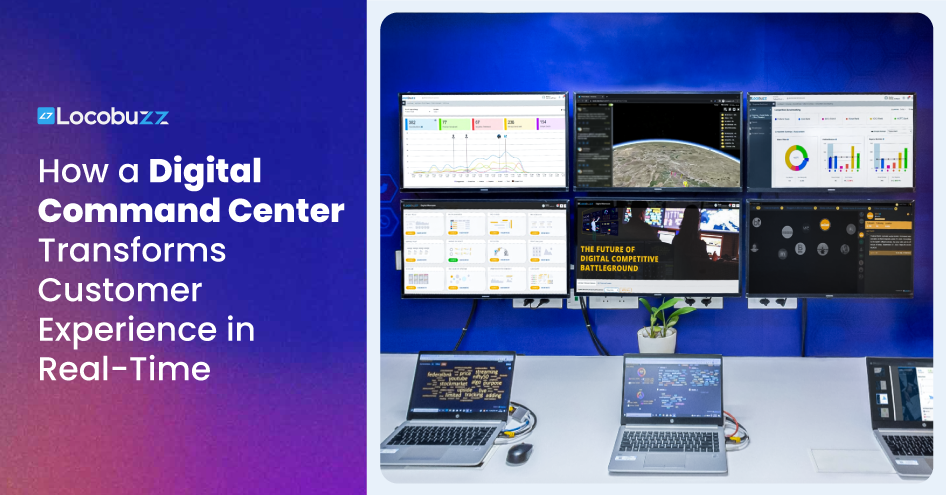
How a Digital Command Center Transforms Customer Experience in Real-Time

TL;DR Locobuzz’s Digital Command Center is a centralized, real-time dashboard that unifies customer interactions, sentiment, and brand signals across social, web, apps, and support channels into a single live view. It helps brands detect issues early, monitor sentiment shifts, align teams instantly, reduce response times, and prevent isolated customer complaints from escalating into CX or PR failures. By empowering support, marketing, and product teams with shared real-time insights, a command center enables faster decisions, proactive service, personalized experiences, and stronger long-term customer relationships. 60% of customers say that a single bad experience with a brand is enough for them to switch brands, while others don’t realise until it’s too late. Today, Customer Experience has become the ‘It’ factor to relate with consumers, creating a point of distinction between lasting brands from forgettable ones.  Most customers engage with brands on digital channels, through websites, social media, apps, and even AI-powered chatbots. To monitor these interactions, you need a Digital Command Center setup.  From providing a bird’s eye view of customers’ interactions to enabling on-the-spot, tailored services, a command center can transform customer experience and build meaningful relationships with customers. Let’s take a look at the core functions of a digital command center is:  Core Functions of a Digital Command Center Provides real-time visibility across customer touchpoints A unified dashboard offers real-time visibility, allowing brands to monitor customer interactions across multiple channels. It helps identify delays, pain point areas, and negative sentiments – allowing teams to acknowledge them before they escalate. Monitors customer sentiments in real-time While tracking interactions, it analyzes customers’ sentiments and understands the emotions behind every comment and feedback. This enables brands to tackle issues before they become a PR crisis. Unified data visualization By combining data from multiple sources, the command center displays critical metrics into a single, live dashboard. Teams get real-time data visuals in one place, ensuring clarity, speed, and confidence in every decision. Cross-team alignment A command center brings every team on the same page aligned to the same data. With a shared view on real-time data, every team sees what’s happening and when it’s happening. This alignment helps in reducing response times, and ensures consistency. Brand health tracking in real-time A command center acts as a live health monitor for your brand. It continuously tracks sentiment trends, brand mentions, and emerging perceptions across social, news, and digital platforms. This real-time visibility gives brands live feedback on the brand’s health, enabling smarter brand decisions. How a Digital Command Center Empowers Different Teams to Deliver an Exceptional Customer Experience? A Command Center is a centralized platform that helps combine data, operations, and communication across multiple business functions. Here’s how a command center empowers different teams: Customer Support TeamsHow it helps: Unified customer view: Real-time access to customers’ history, preferences, and past interactions across platforms. Live feedback loop: Support teams have access to immediate reactions of customers, allowing them to adapt messaging or escalate faster. Cross-team coordination: When different teams operate from the same real-time dashboards, resolution becomes faster and customer-focused. Marketing TeamsHow it helps: Multichannel tracking: A unified view allows marketers to see customer interactions across all channels, ensuring consistent messaging. Faster decision-making:Instead of waiting for weekly reports, marketing teams get a live view of all campaign metrics, enabling smarter and faster decisions. Real-time campaign performance tracking: Marketing teams can monitor how campaigns are performing across platforms by tracking engagement, sentiments, clicks, conversions, and ROI live. Product TeamsHow it helps: Cross-Functional Collaboration:Aligns product, support, and marketing teams on one live dashboard, making it easier to take strategic decisions together. User Behaviour Analytics:A unified view of customer interactions gives product teams an understanding of how customers interact with the products and services. They can brainstorm together & use these insights to guide faster product iterations. To ensure your teams can monitor social in the best possible way, Locobuzz can help set up a Digital Command Center. It offers a unified view of customer interactions from social media, web, and customer support channels. This ensures that brands can easily identify pain points areas, track sentiments, and resolve issues proactively. Locobuzz, as a platform, uses AI-powered analytics to provide actionable insights and allows teams to tailor responses and anticipate customer needs.  With the help of its Social Command Center or a marketing command center, you can sit together with your teams and quickly identify top issues affecting your brand, shorten feedback loops, manage public-facing crisis, and reduce your turnaround time.  Conclusion A Digital Command Center has become the need of the hour. It facilitates the transformation of CX by allowing brands to monitor, analyze, and respond to customer interactions in real-time. Brands can respond faster to queries before they become a crisis, provide customers with timely solutions, personalize interactions, and achieve higher satisfaction.  By tapping into the power of AI and automation, a command center enables businesses to do more than just respond to customer needs, it helps businesses anticipate them – making customers keep coming back for more.

How a Digital Command Center Transforms Customer Experience in Real-Time Read More »

Why Real-Time Brand Monitoring on Social Media has become a Game-Changer

One viral post on Instagram or a single thread on Twitter is all that is needed to go from unnoticed to trending in the social world. Social Media is all about capturing the latest trends. Customers will only stay on your page if it’s trending or relevant to them.  The truth is: If your brand is not listening and reacting quickly, you’re already behind in the competition. The social media landscape is changing rapidly, with trends being replaced by the hour. The solution: Brands need to stay proactive and keep an eye out for all the trends in real time. Or, start a new trend altogether. This is where brand monitoring tools for social media become a game-changer.   Let’s understand what real-time monitoring is: What is Real-Time Brand Monitoring? Brand monitoring enables brands to track mentions, conversations, and trends related to the brand and industry. Brands can listen to what customers are saying across various platforms and respond to comments quickly and effectively.  This involves not just listening to what the customer is saying, but also understanding sentiments behind each comment, and seizing opportunities as they’re spotted. Key components of Brand monitoring: Track brand mentions on & about products and services across social media platforms. Identify key influencers and spokespersons actively talking about trends relevant to your brand. Identify what the target audience is saying about your competitors and their products.List Item Track reviews continuously to gather feedback on customer satisfaction. Monitor news articles and media talks for brand mentions and any PR issues. Track sentiments and engagement metrics to evaluate how successfully the campaign performed. Brands need to move beyond posting and start listening to customers. Let’s take a look at the key benefits of monitoring social media:  Several monitoring tools for social media help brands stay relevant, trendy and ahead of the competition. TL;DR Real-time brand monitoring helps brands track mentions, trends, sentiments, and conversations across social media to understand what customers and competitors are saying as it happens. It enables brands to protect reputation, respond faster to customers, optimize campaigns mid-flight, benchmark competitors, identify influencers early, and improve marketing ROI in a fast-moving social landscape. With real-time social listening, brands can stay relevant, act proactively instead of reactively, turn trends into opportunities, and build stronger customer relationships through timely, data-driven engagement. How Brands Are Maximizing Impact Through Brand Monitoring on Social Media? Proactively Managing Brand Reputation Through social media monitoring, brands can identify and address probable PR issues in real-time. If any negative issue is identified, brands can actively respond and resolve it before it becomes a potential crisis, enabling brands to create and maintain a positive reputation on social media. Improving Customer Service Social media is often the first platform where customers discuss brands. Through real-time monitoring, businesses can provide instant support to customers, allowing brands to proactively respond and improve customer service. Tracking Campaign Performance & Impact Monitoring and tracking brand mentions and customer impressions become an extremely important factor for brands during campaign launch. Brands can not only measure engagement, reach and sentiment, but also refine and modify any changes to maximize impact. Performing Competitor Benchmarking Monitoring is not just limited to your brand, you can also understand how competitors are performing. Brands can effectively track competitors’ mentions, audience engagement, identify effective strategies and pinpoint those that are failing. Identifying Influencers & Spokespersons By utilizing social media monitoring tools, brands can identify influencers already talking about trends and topics relevant to their industry and transform them into brand ambassadors. Improving Marketing ROI By continuous monitoring, brands develop innovative marketing strategies that work best for the customers and bring out the maximum impact. Brands can develop content, and plan campaigns, enabling higher ROI. Brands must recognise that real-time monitoring on social media has become crucial. If they want to stay alert and responsive, brand listening is the key. They can protect their reputation, improve customer service and deliver highly personalized campaigns. Still looking for a stronger reason to implement real-time monitoring on social media? Here are a few case studies showcasing how brands achieved success through real-time monitoring: 1. Nykaa Objective Generate brand presence in beauty and wellness with authentic engagement. How did monitoring help? Tracked mentions of their brand and campaign hashtags like #NykaaBae to evaluate which influencers had the most engagement. Used social listening to analyze audience sentiments on product launches, makeup trends, and content formats. Made adjustments to campaign strategy by identifying high-converting influencers through real-time data. Result   Optimized influencer partnerships, increased engagement and conversions. 2. Zomato Objective Establish a quirky, brand-right social voice and increase user interactions How did monitoring help? Constantly tracking trending topics, memes, and viral conversations on various social media platforms. Identified when and where the brand is mentioned, allowing quick and witty engagement that match the brand’s personality and public sentiment. Monitored competitor campaigns and user feedback which helped refine Zomato’s tone. Result   High audience engagement, strong brand awareness and a spike in social media following. 3. boAt Objective   Stand out in a crowded consumer-tech market How did monitoring help? Listened to conversations about wearables, audio, tech, and competitor brands to spot gaps in customer perceptions. Monitored influencer campaign performance and tracked engagement and sentiments in real-time. Use data insights to refine product messaging to shift from tech to lifestyle branding. Result   Created a youth-oriented, trendy, and tech-savvy brand that became India’s top audio wearables company. Brand monitoring tools for social media help brands stay relevant, trendy and ahead of the competition. One of the most popular tools known widely across India and other continents is Locobuzz. It is an AI-powered social listening and brand monitoring platform. It provides real-time listening across social media platforms, never letting brands miss a single conversation. Brands can keep tabs on relevant industry trends, monitor and measure campaigns as they progress, engage in competitive benchmarking, and ultimately take their business strategies to the next level. Conclusion Conversations on social media change tone and trends overnight, and real-time monitoring has

Why Real-Time Brand Monitoring on Social Media has become a Game-Changer Read More »

Why does a unified customer experience across social, chat, and email matter now?

Why does a unified customer experience across social, chat, and email matter now?

Do you remember the time when you tried to contact a brand for an issue you faced, but for some reason, your issue was not resolved? When you switched channels, you had to explain your problem all over again? It felt like you were talking to a different company altogether, and it took too long for your issues to get resolved. Communication like this is no longer accepted, and it reflects badly on the brand.  Customers no longer view social, chat, and email as separate channels anymore; all they see are brands. However, many companies still operate like separate teams with one logo. A customer might message you on Instagram, follow up on chat, and later email the support team. Unfortunately, they have to repeat their issues from scratch every single time. Today, that market has shifted, and customers expect brands to remember them, recognize them, and respond with the same consistency they would get from a real human who knows them well.  This is why unifying customer experience across social, chat, and email is necessary for survival. Why is it so important to unify messaging across social, chat, and email now? 1. Fragmented conversations lead to instant reputation damage Nothing feels more unprofessional than getting 3 different answers from the same brand. Especially with different tones One tone for social One on chat And another different explanation in the email To a customer, this brand does not know itself at all. A unified system makes the entire brand sound like one consistent voice and not a messy group chat with no context.  2. Your weakest channel can become your reputation Remember that saying, ‘A chain is as strong as its weakest link.’ This line encapsulates this whole point. You might have flawless chat support or great social media responses, but if your email queue is drowning, customers assume that your entire brand is slow. Without omnichannel customer service integrations, your brand will always be judged by its weakest touchpoint. A unified CX platform will eliminate weak links before customers notice them.  3. When your data is connected, your decisions get smarter A scattered system will give you scattered insights, but with a unified system, you get all the important details about a customer. You get the full story behind the customer so you can solve their problems better and personalize the entire experience. You can move from reactive firefighting into proactive intelligence. With digital customer experience management, brands can access all important data in one place, helping make smarter and faster decisions. 4. The brands that win aren’t the biggest, but they are synchronized Your competitors aren’t beating you with bigger teams, but since they are more in sync, they gain a competitive edge over you. With unified CX, brands can be more responsive, intelligent, and reliable simply by being aware of all conversations. Customer engagement platforms assist all brands, whether big or small, to stay relevant in a competitive market simply by being consistent in their tone and messaging.  5. Your competitors are working on getting faster, not just bigger The brands that win today aren’t just the ones with the biggest teams, but they are the ones with the best coordination. A digital customer experience management platform helps to: Respond faster across every channel Solve problems faster before they escalate Spot emerging issues early Maintain one accurate source of information All these factors directly impact revenue, retention, and reputation. Locobuzz provides a unified CX experience across social, chat, and email. This matters because customers move quickly between channels and expect the brand to remember them instantly. Locobuzz solves this by bringing every customer interaction from social platforms into one unified view. All the relevant brand mentions get converted to tickets that are escalated and prioritized through workflow automation to ensure that agents resolve important issues before they turn into full-blown crises. Instead of switching between social, chat, and email, a complete log of a customer, along with sentiment, can be viewed in one place to ensure faster and more consistent responses. Unified Customer Experience Management Platforms – the new way to respond to customers Customers don’t care which team handles their inbox, DMs, or chats; all they care about is the experience. They want to be understood the first time and not the fourth. They expect clear and consistent answers that don’t contradict each other or make them repeat information that the brand should already know. A unified digital customer experience management helps customers from getting lost in a maze of disconnected touchpoints. This ensures that they do not have to restart conversations, re-explain issues, or chase context that should follow them accordingly. Since customers love simplicity and consistency, a unified experience isn’t just better CX, it is your strongest competitive advantage.

Why does a unified customer experience across social, chat, and email matter now? Read More »

What competitive benchmarking on social media really reveals about your brand

What competitive benchmarking on social media really reveals about your brand

Competitive benchmarking on social media is the corporate version of eavesdropping in a crowded cafe – except in this ‘cafe’ people are loudly sharing their opinions, tagging your competitors, and sharing their reactions. It is fast, chaotic, emotional, and brutally honest. That is why it is necessary to pay attention and listen to what is being said at all times.  If you want to know how your brand appears in the wild, beyond boardroom meetings and carefully crafted messaging, social media benchmarking is the spotlight you need. It not only focuses on what your competitors are doing but also on how the market responds to them and what narratives are winning. It shines a light on what you should focus on while exposing gaps and opportunities that you might have overlooked. On social media, where customers tell the truth louder than ever, competitive benchmarking becomes a backstage pass to the real story, one that the audience is already writing for you.  If you’re wondering what competitive benchmarking on social media reveals about your brand, here is a detailed overview: 1. It shows the version of your brand that the market actually sees Inside your company, your brand is heroic, visionary, innovative, loved, and likely considered the best. But on social media? You’re at the mercy of the customers. Competitive benchmarking exposes this contrast. You may think that your products or services are the best, but your competitor may be getting triple the engagement on a similar post. Competitive benchmarking and sentiment analysis tools show you: How do your tone and products compare to the competition? What people appreciate about your customers. What people do not like about your brand It is not just judgment, but the truth, and the only thing that helps you grow. 2. You can move from assuming what they care about to knowing for certain what they like Brands always assume they know what people want, and they make their strategies accordingly.  But competitor benchmarking analysis gives you proof if it is actually true or not. Learning from your competitors can help you be better. It can also show you common pitfalls to avoid to accelerate your growth journey.  Competitor benchmarking uncovers gaps like  Their language might be more readable. They tap into cultural moments faster. They respond quicker to comment.  They use a story language you overlooked.  This shows you what the audience is resonating with and what themes create a stronger emotional pull. 3. Helps you understand where you are falling behind Sometimes, you might not realize that the competition has quietly taken over a conversation or market segment that you once dominated. You might have led a category in the past, but your competitor might have slipped into the narrative and stolen the spotlight. Benchmarking helps highlight these shifts early. You can get a better understanding if your competitor is doing well and working in a gap that you missed. At the end of the day these are not just metrics; something like Instagram competitor analysis helps show warning signs from the market. The earlier you see them, the easier they are to fix. 4. Reveals the emotion behind engagement Competitor benchmarking extends beyond just likes or views. It highlights the emotion behind the conversations. Are your competitors’ posts receiving appreciation while your posts receive frustration? What are the posts about? Sentiment analysis tools help in understanding the emotion behind what is being said helps create products and messaging to gain customers who advocate for your brand. It also helps understand if your brand is creating more loyal customers purely through better engagement or through a superior product. 5. Helps spot emerging trends in your category When multiple brands in your category start discussing the same idea at the same time, it means that the market is shifting. Transparency or convenience might be something competitors are focusing on, and it’s gaining traction. Humor may have become a lever of engagement. There are many trends that pick up over time, and these can be capitalized on if they are caught on time. Social brand reputation monitoring tools help see these patterns when competitors use them or before they become mainstream so that you can adapt quickly and go with what works.  Locobuzz helps brands benchmark against key competitors on social media by turning every digital conversation into clear, actionable insights. By tracking engagement levels, sentiment patterns, content performance, and audience reactions, Locobuzz shows brands exactly where competitors are outperforming them and where the gaps still exist. Furthermore, unified dashboards and AI-driven insights offer a single, strategic view of the entire competitive landscape to help marketing, CX, product, and leadership teams to make faster decisions based on what the market is saying and not assumptions. Locobuzz gives leaders the foresight to respond to issues and capitalize on moments before the competitors do so.  Conclusion Competitive benchmarking is the compass that guides your brands forward. It shows you where you stand today and reveals the opportunities you can capitalize on. Instead of guessing what to fix or where to focus, you get a clear, data-led perspective that points you in the right direction. When you fully understand what people are talking about, you stop playing catch-up. You stop mirroring what the market does. Instead, you set the pace, redefine expectations, and lead the narrative that everyone else tries to follow. 

What competitive benchmarking on social media really reveals about your brand Read More »

Using Social Media Market Research to Upgrade Brand Market Research and CX Decisions

Using Social Media Market Research to Upgrade Brand Market Research and CX Decisions

Imagine trying to have a conversation with someone once every 3 months. You’d miss out on everything that actually matters – the mood changes, the new obsessions, the frustrations, and the subtle shifts in what they like or dislike. By the time you check in again, they are practically a different person. That’s how most brands still operate. They still use:   Quarterly surveys Annual reports One-off feedback studies While traditional research is still viable, customers do not speak in quarterly cycles anymore. They share their opinions every minute, publicly on social media.  That is why social media is no longer a marketing channel. It has become a source of real-time social media brand market research for brand leaders to transform their strategy, enhancing customer experience. Why is social media research an upgrade for brand market research? 1. People won’t always fill out a survey, but they will speak on social media While feedback forms are always sent out, they don’t always get a response from customers. However, they are more likely to go to social media and speak their mind. What annoyed them  What delighted them What confused them What felt slow Which competitor do they prefer?  This makes market research for social media a more honest assessment as opposed to more traditional market research. 2. Traditional Research Is Slow, while Social Media Is Always On Traditional research is a longer process. Instead of waiting for weeks or months for a research cycle, social media listening tools can provide insights more quickly as they happen in real time.  Through effective social media research, business leaders can: Track sentiment changes in real-time Spot problems as soon as customers post about them. Understand customer expectations as they evolve and change.  Identify trends before competitors do Enables proactive responses to launches and issues. This shift from delayed reports to real-time information using an audience insight tool keeps brands ahead of customer expectations. 3. Social Media Shows How Customers Really Behave Online Market research done through social media listening tools helps brands understand the exact sentiment that customers have for the brand. While traditional market research can be accurate, social media listening tools shine a light on the unfiltered opinion of consumers. Every comment, share, review, and complaint tells you something. Not just what customers say and how they say it.  Brands can understand: What triggers frustration What causes customers to switch brands?  What features matter the most What messaging confuses people? What stops customers from completing a purchase?  Deeper insights like these cannot be acquired from surveys or reports alone. 4. Better CX decisions start with better signals. CX breaks down when leaders cannot see what customers feel. CX platforms show better signals, and this helps leaders understand what customers feel and not just what they say.  Social media research highlights: Issues that constantly resurface Service delays Positive moments that are worth amplifying Common complaints and pitfalls Tracking these metrics helps constantly monitor brand health to understand what works and what doesn’t. 5. A Powerful Tool for Brand Strategy and Competitive Intelligence Social media research does far more than shine a light on customers, but it also shows how the entire market evolves.  Social media listening tools brands track metrics like Competitor launches Customer reactions to rival campaigns Shifts in pricing  Industry trends This turns brand decisions from guesswork into a more evidence-based strategy. Locobuzz is a powerful AI-powered CX platform that listens to real-time conversations across social channels, enabling brands to understand what customers genuinely want, feel, and expect without relying on delayed surveys, focus groups, or traditional research methods. Along with deep sentiment analysis in over 200 languages, the platform also offers powerful competitor benchmarking to reveal how the brand compares with competitors in its category. These insights help strengthen brand research, sharpen strategy, and empower smarter, faster CX decisions. Social media research – the advantage modern leaders can’t ignore Social media is the world’s biggest and most honest customer focus group – speaking 24/7, without filters or delays. It understands what customers feel long before any reports or surveys. This makes it important for all business leaders to use social media for market research, as it enables them to make decisions with clarity and confidence.  This shift doesn’t just enhance customer experience, but it elevates brand strategy, helps stay aware of competition, and helps stay relevant, responsive, and ahead of the market. Social media listening tools are no longer optional for brands – they are essential.

Using Social Media Market Research to Upgrade Brand Market Research and CX Decisions Read More »

Book free demo !

Personal data will be processed in accordance with Locobuzz’s Privacy Policy